Welcome to my Honors Portfolio
My name is Elyse Nutter, Class of 2028 and Honors Student
As an Honors student at the University of Maine, this portfolio reflects my academic growth and the values that shaped my learning experience. The artifacts included here come from the Civilizations sequence. In those courses, I was pushed to think critically, make connections across subjects, and engage with ideas beyond one classroom. Through literature, art, philosophy, and personal reflection, I became a stronger writer and thinker. I also learned how class ideas can connect to real life.
This portfolio is organized to show how my thinking and writing developed over time. Some artifacts are personal and creative. Others are analytical and focused on argument. Together, they show how Honors encouraged me to take risks, ask deeper questions, and share ideas with confidence. Themes such as identity, grief, morality, language, and human nature appear throughout these pieces.
I chose these works because they show growth in both skill and confidence. Earlier assignments reflect the start of my Honors journey. Later pieces show a stronger ability to connect ideas and build meaningful arguments. This portfolio is more than a group of assignments. It shows where I started, how I grew, and the kind of thinker and writer I am still becoming. Feel free to click Gallery, where you will be taken to my chosen artifacts that reflect my Honors experience so far.

8 Artifacts~
Artifact 1: Writers Profile
In my Writers Profile, there is this reflection towards my skills and weaknesses within the Honors course. I discuss my previous experiences in writing, which include IB English and IB TOK. Those courses helped me develop critical thinking skills when it came to a piece of work. We looked at a variety of works from Shakespeare, to Christopher Nolan. Translating that into my University work, I am far more prepared to take on loads of work within a short period of time. I talk about how I excel when it comes to opinion based prompts. Open ended questions tend to peak my overall interest. On the other hand, I do struggle with free writing. I can't build an idea off of nothing, so being given a prompt tends to initiate my critical thinking. I talk about overcoming these challenges by taking time out of my day to write. This can look like starting or ending my day with my prayer journal, where I sort of just say what's on my mind. This is important because my religion is foundational to everything I observe in life. Other times, I'm just writing in a notebook some ideas or thoughts from my classes. This has helped tremendously in coming up with ideas for free writes.
Artifact 2: Loss of a Loved One
In this creative assignment, I explored the theme of grief through personal circumstance and symbolism. I connected the topic of loss to the passing of my grandfather, who was someone that had a major impact on my life. He helped shape my love of learning and education, and ultimately pushed me to where I am now. Rather than just describing grief, I compared loss to the seasonal changes of trees. This gave me a way to express emotion through imagery and nature.
The changing seasons represented how loss can feel sudden and painful, but also how healing and renewal can come with time. This particular prompt stuck with me, as my Grandmother passed just a few hours after I wrote it. It's hard to grasp I had just been reflecting on her husband's impact on my life, and now her. I also look at it in a way that was able to help me heal. I talked about the changing of the seasons, and how that suggests renewal. Healing from that deep, sudden loss was aided in the ability to write. Come Spring, it represented hope and growth after that time. I think this artifact shows my ability to blend personal experience with larger themes in a creative way. It also reflects how I use writing to process emotions and make meaning out of difficult experiences. This really was early on into my Honors experience, and its so meaningful to look back on.
Artifact 3: Niagara Falls, Thomas Cole
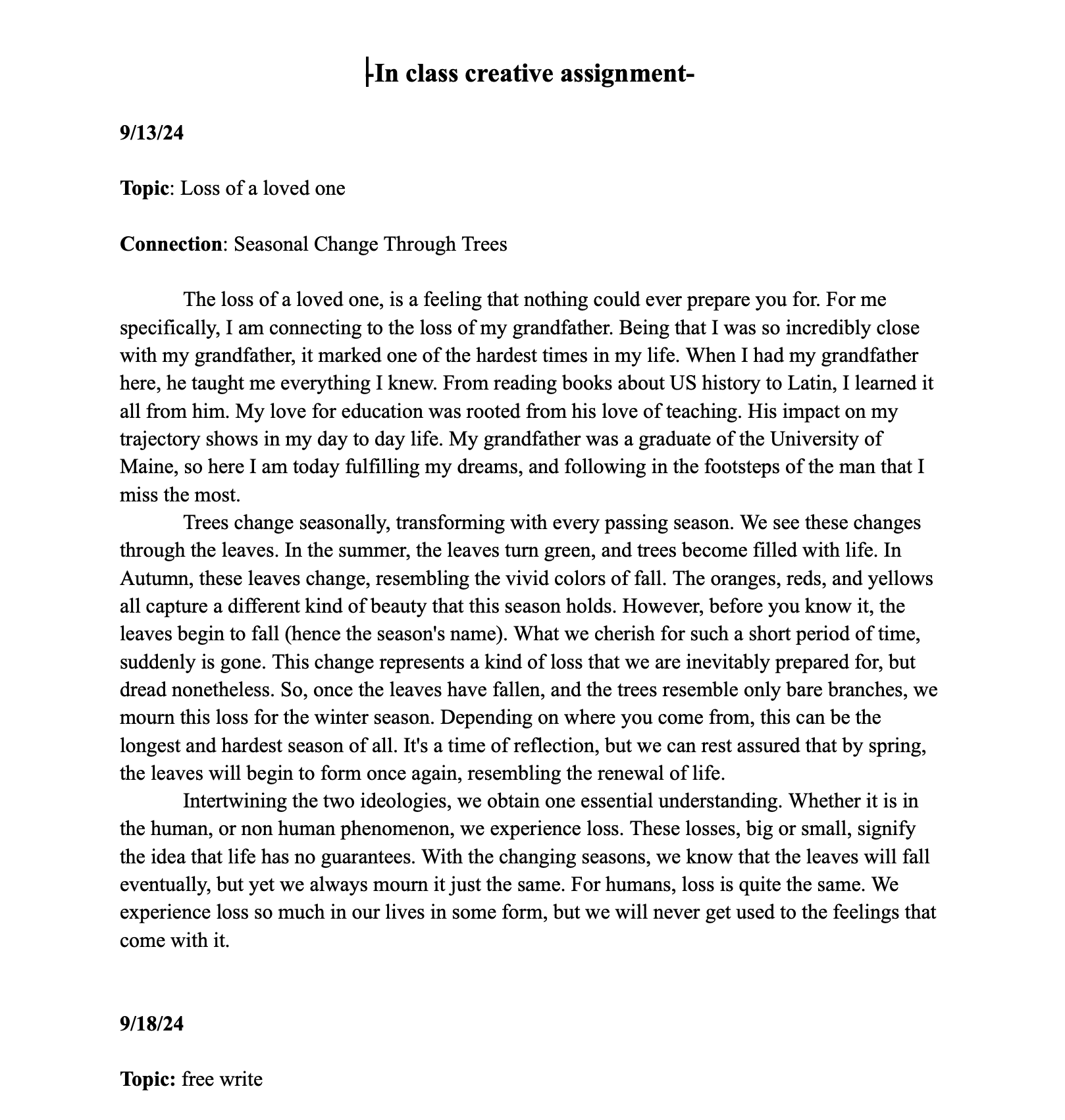
This artifact was a weekly response in which I analyzed Thomas Cole’s painting The Distant View of Niagara Falls, and connected it to themes from Frankenstein. I focused on ideas of nature and otherness. While observing the painting, I saw a landscape where many different elements of nature worked together. I used that image to think about the creature in Frankenstein and how society rejects what it does not understand. What made this piece valuable was the way it combined visuals with literature. Rather than treating art and text as separate subjects, I explored how they can speak the same language. I discussed how the creature is judged for his appearance and how readers begin to sympathize with him over time. This connected well with the painting’s sense of balance and belonging within nature.
This artifact shows my growth in interpretation, and how I understand otherness as a concept. It reflects my ability to think critically about symbolism and imagery. It is also meaningful because it demonstrates how Honors courses encouraged me to think beyond one subject at a time. To look at the larger picture. I learned that art and literature often overlap in powerful ways when discussing identity and acceptance.
Artifact 4: Language Through Various Texts
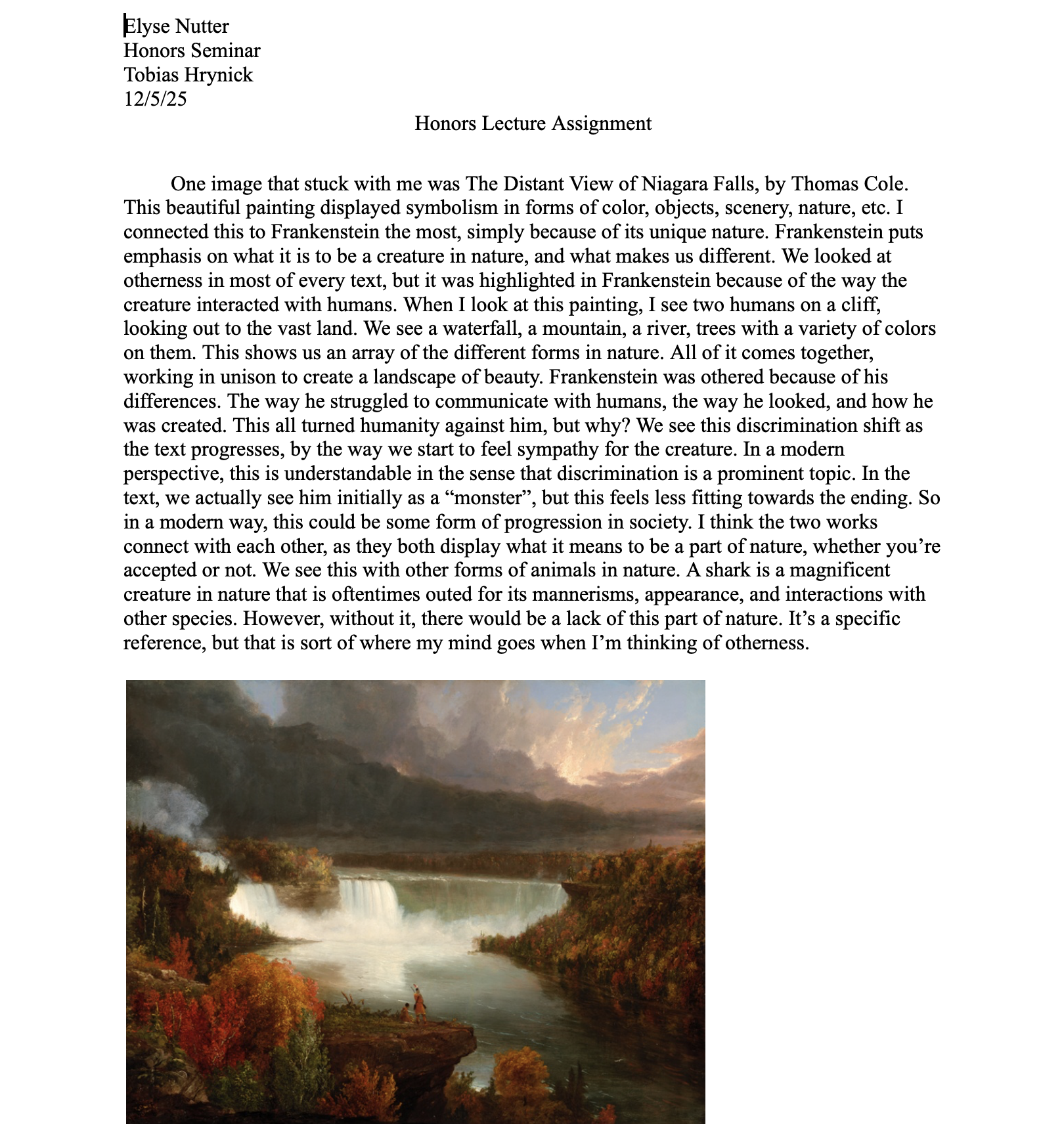
In this analytical essay, I explored the idea that language can both reveal meaning and limit it. I used several texts, including the Torah, Tao Te Ching, and the story of Inanna, to examine how different cultures understand communication. My main idea was that some of the deepest human experiences may exist beyond what words can fully explain. This artifact is important because it challenged me to think in a more philosophical and comparative way. Rather than summarizing texts individually, I looked for a shared theme across very different traditions. I discussed how language can connect people to knowledge, religion, and identity, while also showing its limits when dealing with emotion. I chose this artifact because it represents intellectual risk taking. It pushed me to write about abstract ideas that did not have one simple answer. I think that's the beauty of Honors, to learn what it means to think beyond one solution. It also reflects my interest in spirituality, belief, and deeper meaning, which are themes that continue to matter to me as a religious individual. This essay shows that I am willing to engage with difficult concepts and search for connections between texts that at first seem unrelated.
Artifact 5: Beware of Luxury
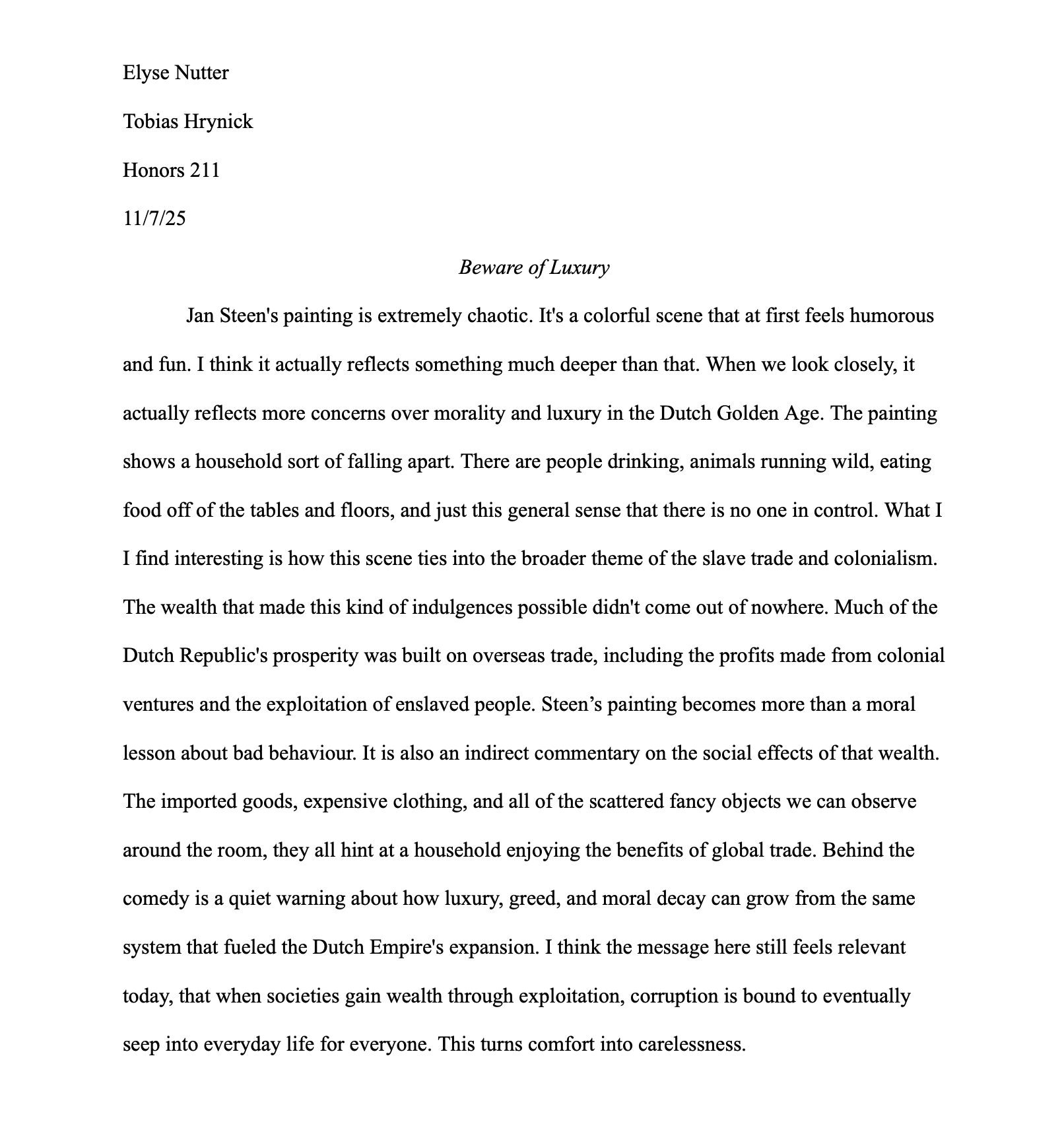
This analysis essay focused on Jan Steen’s painting and the message hidden beneath its chaos. I argued that while the scene may first appear playful, it also serves as a warning about greed and moral disorder. I looked at how the cluttered household and lack of control symbolized the dangers of luxury and careless living. What made this artifact meaningful was the way I connected art to larger historical systems. I discussed how wealth and comfort often come from deeper social and economic structures. This helped me move beyond simply describing a painting and instead think about what art can reveal about society. I learned that images can show behaviour just as strongly as written texts can.
This piece demonstrates my ability to closely observe details and build a larger argument from them. It also reflects growth in understanding that art is often layered with social commentary. I chose this artifact because it shows how Honors classes taught me to question appearances and look beneath the surface of a work. I can also connect my ability to dig into authors' choices from my high school IB courses. Ultimately, something that seems humorous or decorative can still contain a serious message about human behavior and values.
Artifact 6: The Power of Self
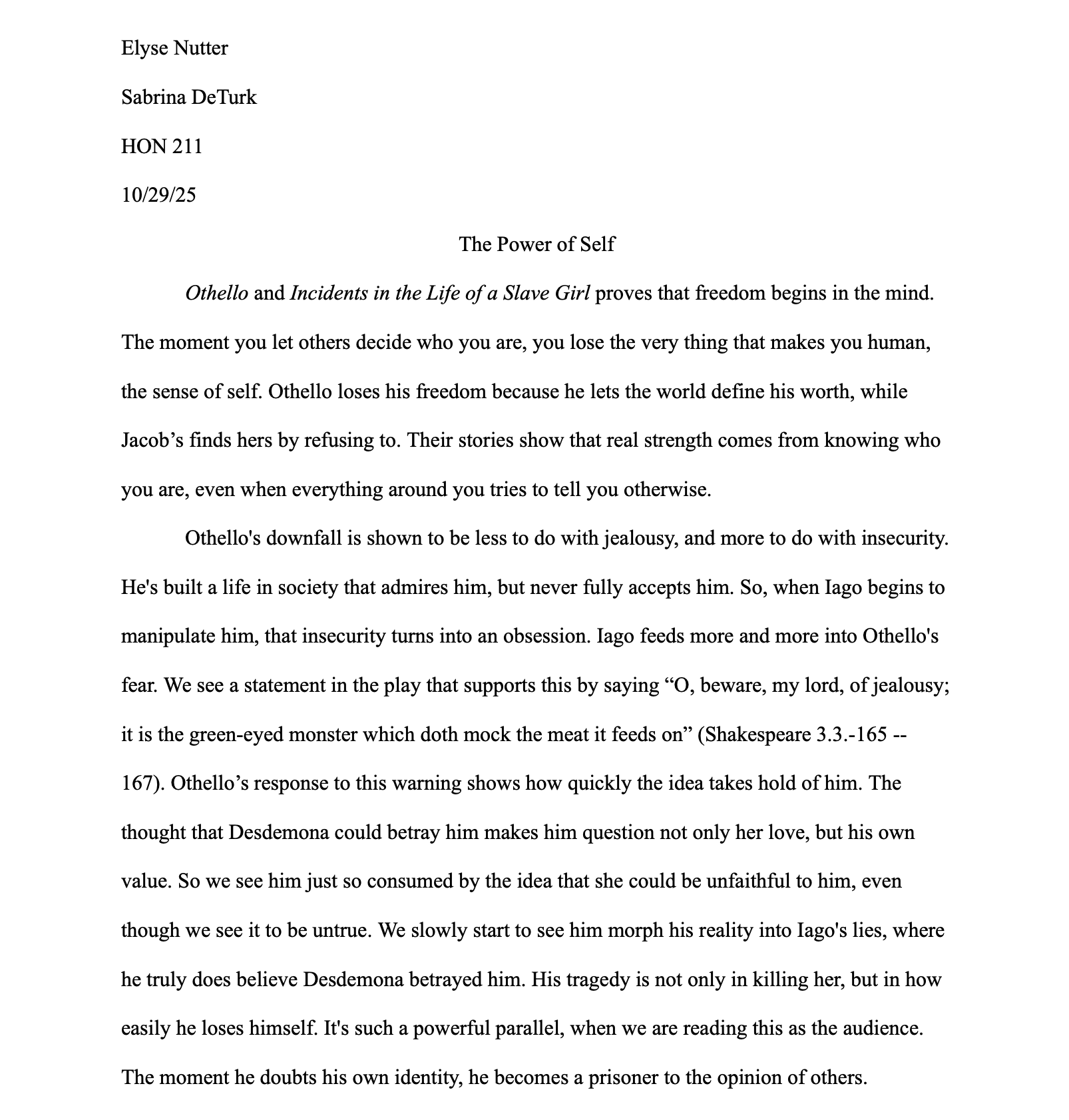
In my literary analysis essay, I compared Othello and Incidents in the Life of a Slave Girl through the theme of identity. I argued that freedom begins with a strong sense of self, and that losing control of one’s identity can be destructive. Othello becomes trapped by insecurity and the opinions of others, while Harriet Jacobs resists systems that try to define and silence her. This artifact is important because it reflects my ability to compare two very different texts through one meaningful theme. Rather than only discussing plot, I focused on how both characters respond to the pressure from control, as well as outside judgment. This allowed me to examine resilience in a thoughtful way.
I also chose this piece because it shows growth in analytical writing and confidence in building an argument. Being a more reserved individual, it tends to reflect in my writing as unconfident. My writing here represents a topic I care about personally, which is the importance of knowing who you are despite outside influences. This essay demonstrates that literature can reveal truths about self worth and freedom. It reminds me that strong writing often comes from connecting texts to real human struggles that still matter today.
Artifact 7: Frida Kahlo, Remedios Varo, and Metamorphosis Poem
This poem was inspired by artists Frida Kahlo and Remedios Varo, along with themes of transformation found in The Metamorphosis. In this piece, I used imagery and symbolism to explore identity, pain, and the inner self. These artists and texts all examine what happens beneath the surface, which gave me strong inspiration for creative writing. I chose this artifact because it shows a different side of my writing abilities. Much of my academic work focuses on analysis. This poem allowed me to be imaginative while still engaging with course themes. I was able to take ideas from visual art and literature and turn them into something original.
This artifact is also meaningful because it reflects confidence in creative expression. It demonstrates how Honors courses encouraged me to think beyond traditional essays. I learned that poetry can communicate emotions and ideas in ways that formal writing sometimes cannot. Including this piece in my portfolio shows balance in my abilities as both an analytical and creative writer. It reminds me that strong thinking can appear in many forms, not only in research papers or responses.
Artifact 8: Honors Lecture Reflection (The Metamorphosis and Surrealism
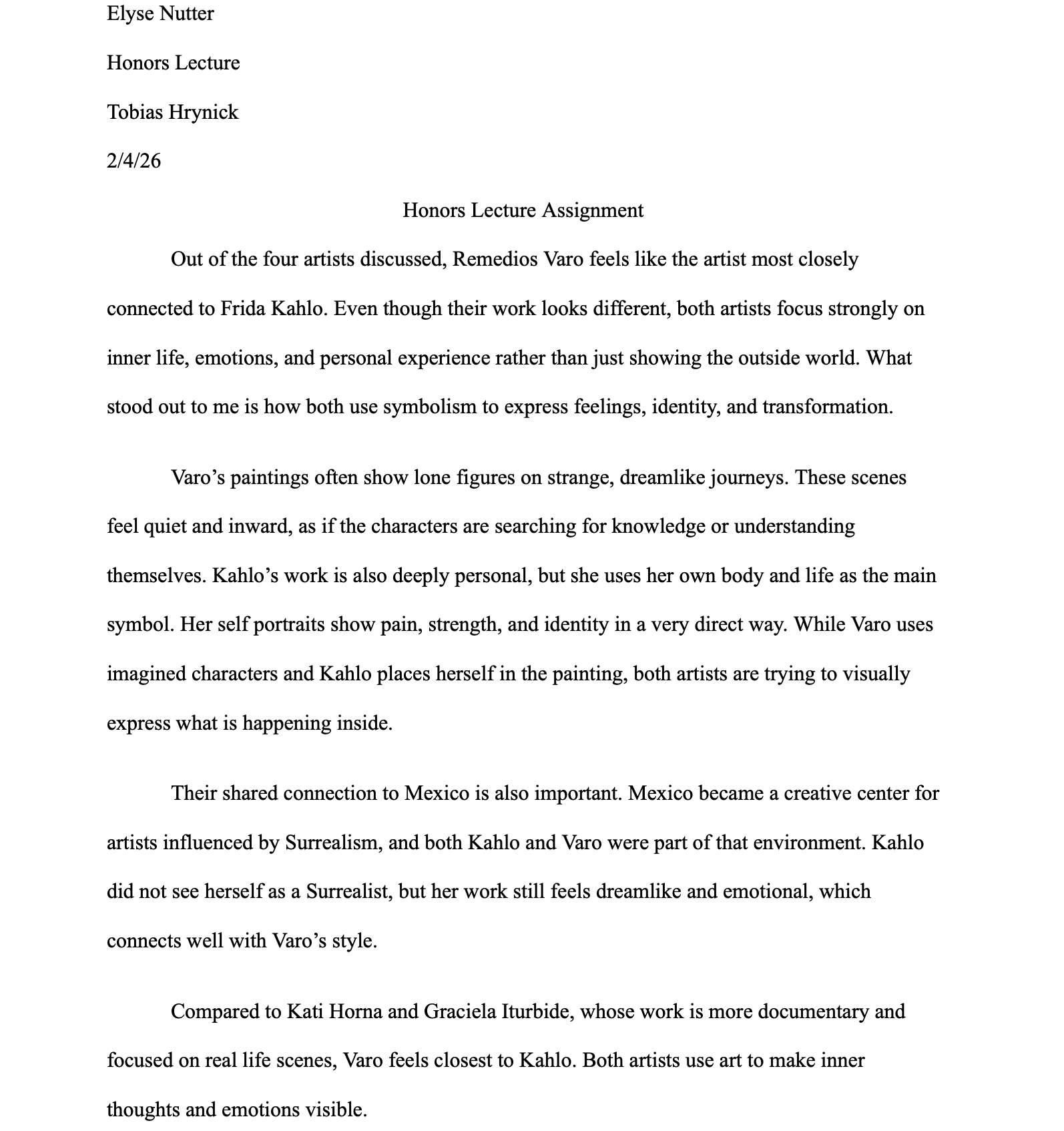
In this lecture reflection, I examined why The Metamorphosis connects more closely with Surrealism than Dada. I argued that Kafka’s story uses strange and unrealistic events not simply to shock readers, but to reveal deeper emotional truths. Gregor Samsa’s transformation becomes a symbol for otherness and loss of identity, quite like we see in Frankenstein. This artifact is still important to include in this list of artifacts because it shows my growth in using art to interpret literature. I compared Surrealism and Dada, then applied those ideas directly to the text. This required me to understand abstract concepts and explain them clearly through examples from the story. This piece reflects stronger academic confidence and clearer argumentation. Rather than only reacting to the lecture, I built my own interpretation and supported it with evidence from the text. It also shows my interest in literature that explores the inner mind and human emotion. This reflection represents the kind of writing I developed later in the Honors program, especially in Professor Deturks and Professor Martins courses. It is more focused, more analytical, and more confident in my own ideas. It's been a great journey learning to become confident in my ability to form an argument. Taking this confidence further in my college experience will be greatly influential.